
 Source: Wikimedia
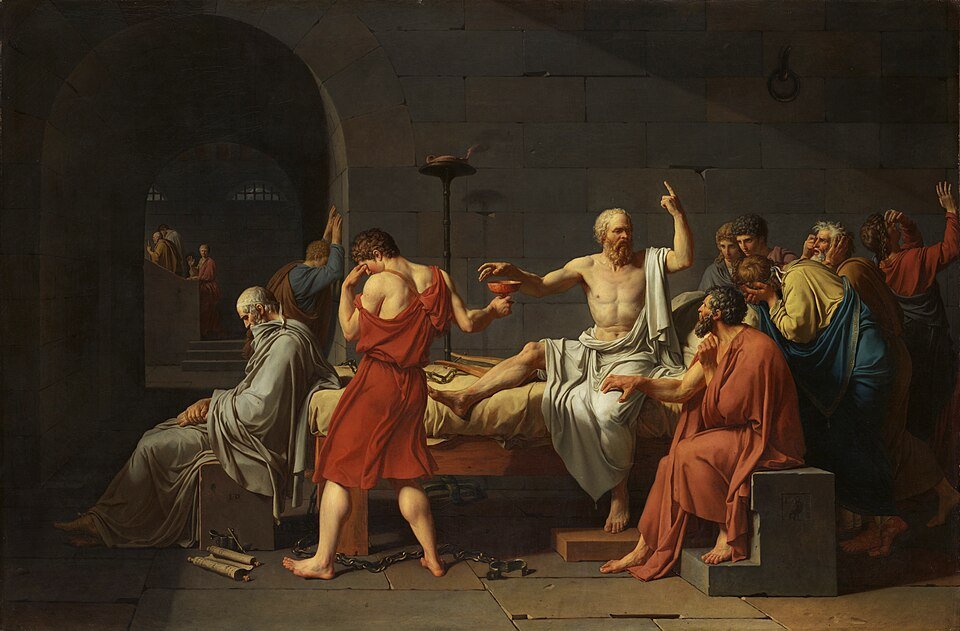
In his dialogue Thaetetus, Plato reports Socrates saying that “philosophy begins in wonder”. About 2300 years later Alfred North Whitehead added that “when philosophical thought has done its best, the wonder remains”. Thus philosophy both begins and ends in wonder according to the above. I think the same should be said for naturalist spirituality.
What is wonder though and why is it so important? There are two senses of the word wonder, the first describes a feeling of amazement or awe, the second meaning to ponder or speculate from a place of uncertainty or curiosity
When Socrates used the word thaumazein, θαυμάζειν, and Whitehead the word wonder, they had both senses in mind. To them, we should not just be awestruck at nature but be alive to the fact that even after a lifetime of learning and inquiry, we will remain ignorant about much of it, about the origins of the cosmos or the nature of life and consciousness for example. Another way of stating this conclusion is to say that a big question mark hangs over existence, that in many respects it is and will always be shrouded in mystery.
In a recent conversation a friend of mine queried my use of the word ‘mysterious’ to describe what I thought of as a fundamental aspect of reality. He felt it was too closely related to the idea of mysticism.[1] I apologize to my friend in advance, but I immediately thought of the puffed up character Mr Gradgrind, in Charle’s Dickens’s novel Hard Times. “Facts alone are wanted in life” he says, “Plant nothing else, and root out everything else … nothing else will ever be of any service …”. Mr Gradgrind is so amusing because his outlook is so ridiculously narrow-minded.
__________
Our November Online Conference
The Spiritual Naturalist Society warmly invites you to Convergence, a free two-day online gathering dedicated to exploring the many ways people find meaning, wonder and ethical inspiration within a naturalistic understanding of the world. Our aim is to converge some of the most promising visions for the future of secular meaning-making in one place. This event is designed for the widest possible spectrum of participants — from longtime practitioners to curious newcomers — who share an interest in forms of spirituality grounded in nature, human experience and the realities revealed by science. For more information and to register, visit our conference page.
__________
Yes we should reject out-of-hand all varieties of mysticism, but I think a healthy sense of mystery is something quite different, and has an important place in naturalistic philosophy and spirituality. To acknowledge mystery is not only to acknowledge that we don’t know everything, but to acknowledge that everything we already know is at best provisional. There is a good chance that a hundred years from now the pinnacles of our current scientific theories like Quantum Field Theory, the Standard Model of particle physics and Big Bang cosmology will be hopelessly outdated. Already cosmologists are speculating about things like the multiverse, many-worlds, exotic matter outside the Standard Model and cosmoi preceeding the Big Bang. To even dream we are anywhere near close to a final theory of things seems to me premature at best. If the most thoroughly tested and empirically supported theories in human history stand on shifting sands then what might be said about ideas in areas like philosophy, religion and politics?
Although we are all wedded to certain beliefs about how the world is, it seems to me that extreme certainty is always problematic. Rigidly dogmatic beliefs about anything incline the believer to an unwarranted sense of righteousness that is not only closed to different points of view, but lends itself to violence in temperament and behaviour. Unfortunately, for the last few thousand years, Western thought, especially in religion, and even science, has been captivated by the idea of absolute certainty. Perhaps this goes back to the massive influence of Greek mathematics on Western culture, the supreme expression of which was Euclid’s geometry textbook The Elements (c 300 BCE). The Elements stood as a towering edifice over European thought for well over a thousand years. His tome employed steely logical deduction to reach unwavering conclusions, a method employed by Ptolemy to calculate the orbits of the planets and relied on by Newton to formulate his theory of gravity. It was even emulated by European thinkers like Spinoza and Leibniz in theology, and by Thomas Hobbes in political philosophy. The latter efforts in this regard all seem rather quaint today. But Western culture still suffers from a hangover induced by its intoxication with the Euclidian mode of thought. It is arguable that a lot of contemporary American and European philosophy for example, especially in the Analytic tradition, remains attached to the vain hope of discovering final truths about nature and life via strict logical reasoning.
But we ought not be too confident in our beliefs however they have been arrived at. Every piece of knowledge is a fallible human artifact, valuable for a time in certain contexts, but ultimately dispensable should the situation demand it. The same holds for every product of human imagination and creativity: concepts, words, arguments, theories, propositions, business models, mathematical formulas, religious beliefs, political constitutions, laws, political ideals. To cling to an absolute of any kind is to court the danger of holding to something even when it is no longer valid, like keeping food past its used-by date. We should rather hold ideas only to the extent they are supported by all the available evidence, and embrace virtues like flexibility, adaptability and intelligence to guide us as to which are the most suitable in the circumstances.
Even then, whatever belief or project we commit ourselves to is always a bit of a gamble. We can never be absolutely sure. A scientific theory, a marriage, a career, the space program, everything we do as individuals and as societies involves risk and uncertainty, however much evidence we accumulate in their favor. Failing to appreciate risk is over-confidence, which also goes by the name of ‘hubris’. Over-confidence has led entire nations into devastating and un-winnable wars, to economic depressions, and to human tragedy in every area of life. The opposite is a sense of humility. Thus cultivating humility is probably a wise thing to do. Nowhere is this more important than in questions of religion and spirituality which address the fundamental problems of life itself: how to live, what is of utmost value, and what ideals to hold fast to when everything else around you is falling to pieces.
Sadly, religionists of all stripes are often the least humble people there are, with large contingents of incredibly intolerant adherents, despite often being completely ignorant about the most basic of scientific and historical facts, and their supposed support of principles like love and respect for humankind. It would be good for all concerned if instead of closing themselves off to mystery and saying ‘it is only for God to know’, they appreciated how the vast beyond dwarfs all our pretensions to ultimate truth, and how limited our purported knowledge of the world actually is.
Appreciating mystery does not lead to simple dumbfounded-ness though, but to something more moving. It stimulates in us vague imaginings as to what might exist beyond the horizon and to wonder at the profound complexity of even the simplest of things, ‘To see a World in a Grain of Sand, And a Heaven in a Wild Flower’ as the poem goes. I suggest that such states of mind are conducive to a more tolerant and cosmopolitan society. So yes, philosophy should begin and end in wonder, but concomitantly, never lose its sense of uncertainty and mystery.
In another of Plato’s dialogues, Timaeus-Critias, Socrates gets into a long conversation with Critias about the origins of the world. Critias offers his own elaborate theory involving the divine perfection of the gods, earth, air, fire and water, and some strange and troubling notions about where women come from. His speculations by today’s standards are interesting but scientifically irrelevant. But at a time when the earth seemed so big, when science was barely distinguishable from myth, and faraway cultures and places so strange and mysterious, thinkers like Plato were intensely aware of how limited their ideas were. He has Critias offer sage advice in this regard. He says that as imperfect mortals, our accounts of the universe bear at most only a likeness to how things truly are, that the best we can hope for is a likely story.
Don’t therefore be surprised, Socrates, if often concerning many matters — the gods and the coming into being of the universe — we show ourselves unable to render accounts that are, in every respect and completely, consistent with themselves and accurate. Rather, you must be satisfied if our accounts are no less likely than anybody else’s, remembering that both I, the speaker, and you, the judges, have a human nature. So it is right that in these matters you should accept the likely myth and look no further than this.
[1] The belief in occult or esoteric truths inaccessible to reason and science as might be found for example in some New Age and traditional religions. I find mysticism almost a contradiction in terms because it presumes to know what by definition is unknowable.
Thanks for writing this Dwayne. I agree with you that mysticism defined as “belief in occult or esoteric truths inaccessible to reason and science” is unhelpful for Spiritual Naturalists. However, mystical experience as a subjective experience of the mysterious, does not require belief of any kind. In fact, mystical experiences can be a unique incubator of uncertainty and wonder. I wrote more of my thoughts on it here: https://www.snsociety.org/everyday-mysticism/.